
In a moment that many in the AI community have been anticipating for the better part of two years, OpenAI officially unveiled GPT-5 on April 22, 2026 — a model the company describes as its most significant leap forward since the original ChatGPT launch. The announcement, delivered via a live-streamed event from OpenAI's San Francisco headquarters, drew millions of simultaneous viewers and immediately sent ripples through the technology sector.
GPT-5 is not merely an incremental update. According to OpenAI CEO Sam Altman, the model represents a qualitative shift in how AI systems approach complex reasoning, moving from pattern-matching toward something that more closely resembles structured deliberation. 'We've crossed a threshold,' Altman said during the keynote. 'GPT-5 doesn't just retrieve — it reasons, plans, and verifies its own conclusions in ways previous models simply could not.'
What Makes GPT-5 Different
The most striking capability of GPT-5 is its extended context window, which now supports up to one million tokens — roughly the equivalent of ten full-length novels processed simultaneously. This allows the model to maintain coherent reasoning across extraordinarily long documents, making it genuinely useful for tasks like legal contract analysis, scientific literature review, and multi-session software development projects.
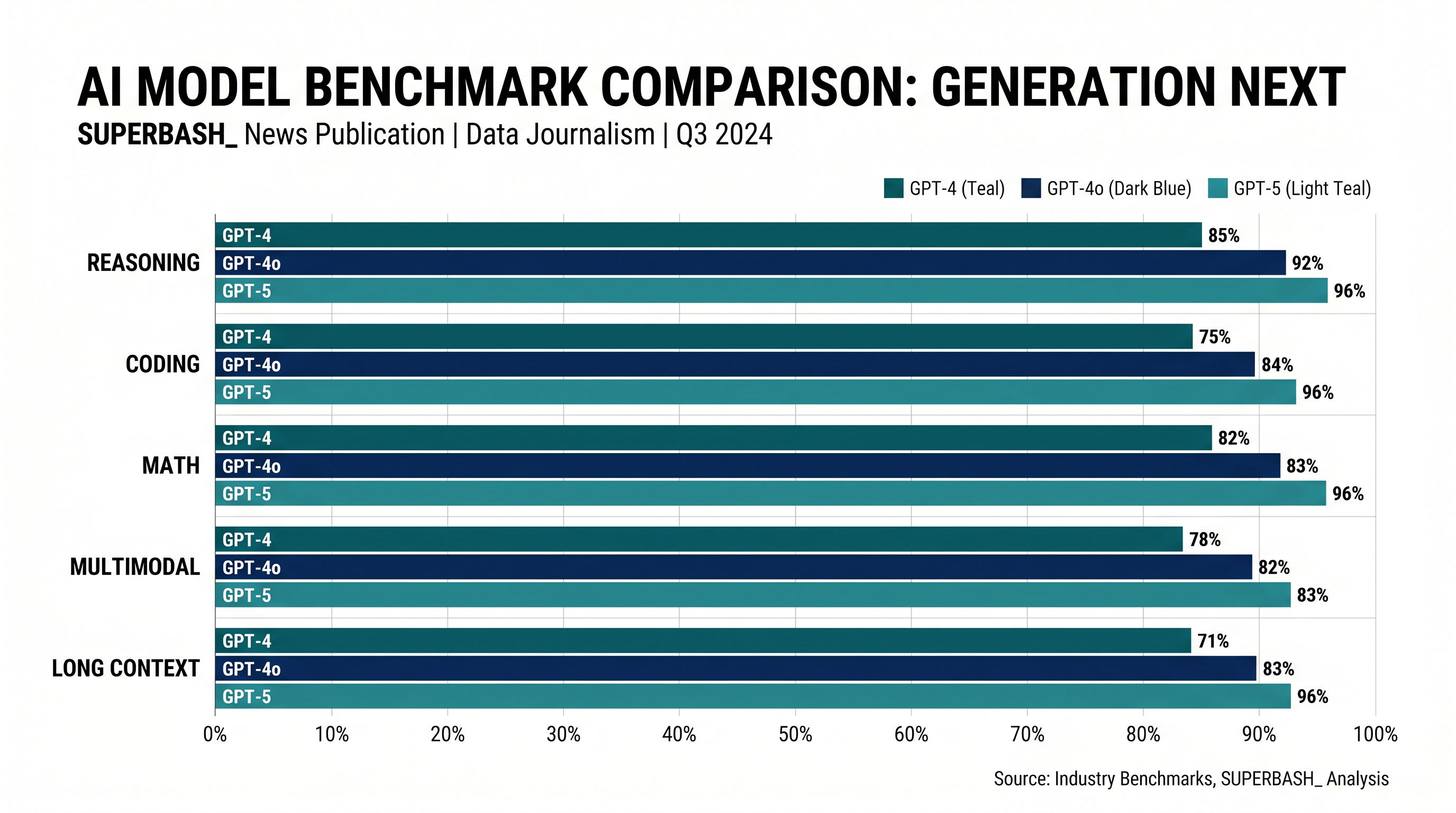
But raw context length is only part of the story. OpenAI's internal benchmarks, published alongside the release, show GPT-5 outperforming GPT-4o by 47% on the MATH-500 benchmark and by 38% on HumanEval, the standard coding proficiency test. On the MMLU Pro benchmark — a comprehensive test of professional-level knowledge across medicine, law, engineering, and the sciences — GPT-5 scores 91.2%, compared to GPT-4o's 72.6%.
Data Visualization
GPT-5 vs. GPT-4o: Benchmark Performance Comparison
- GPT-5
- GPT-4o
Multimodal Capabilities and Real-World Applications
GPT-5 also marks a significant advancement in multimodal reasoning. The model can now process and reason across text, images, audio, and video simultaneously, enabling use cases that were previously impossible. A medical professional can upload an MRI scan alongside a patient's written history and receive a structured differential diagnosis. An architect can share blueprints and receive detailed structural analysis. A software engineer can describe a bug verbally while sharing a screen recording and receive a root-cause analysis.
"We've crossed a threshold. GPT-5 doesn't just retrieve — it reasons, plans, and verifies its own conclusions in ways previous models simply could not."
— Sam Altman, CEO, OpenAI
Pricing, Access, and the Competitive Landscape
GPT-5 is available immediately to ChatGPT Plus and Pro subscribers, with API access for developers launching in a tiered pricing structure. The base API rate is set at $15 per million input tokens and $60 per million output tokens — significantly higher than GPT-4o, reflecting the model's substantially greater computational requirements. Enterprise pricing is available through direct negotiation with OpenAI's sales team.
The timing of the release is strategically significant. Anthropic's Claude Mythos, released just two days prior, had briefly claimed the top position on several public leaderboards. GPT-5's arrival immediately reshuffled those rankings, and the two companies are now locked in what analysts are calling the most consequential AI performance race since the original GPT-3 launch in 2020.
Google DeepMind, which has been quietly developing Gemini Ultra 2, is expected to respond within weeks. The competitive pressure is intensifying at a pace that is forcing all major AI labs to accelerate their release timelines, raising questions among safety researchers about whether adequate testing is being conducted before deployment.
Safety Considerations and Alignment Research
OpenAI has been unusually transparent about the safety evaluations conducted on GPT-5. The company published a 94-page technical safety report alongside the model release, detailing red-teaming exercises, adversarial testing, and the results of its Preparedness Framework evaluation. GPT-5 received a 'medium' risk rating overall, with 'high' risk flags in the categories of persuasion and influence operations — areas where the model's enhanced reasoning makes it potentially more capable of generating convincing disinformation.
To mitigate these risks, OpenAI has implemented several new safeguards, including enhanced content filtering for political content, mandatory watermarking for AI-generated images, and new monitoring systems designed to detect coordinated misuse patterns. Critics argue these measures are insufficient given the model's capabilities, while OpenAI maintains that the benefits of deployment outweigh the risks of withholding the technology.
The release of GPT-5 marks a pivotal moment not just for OpenAI but for the entire AI industry. The question now is not whether AI systems can perform at near-human levels on complex cognitive tasks — GPT-5 has answered that — but rather how society will adapt to a world where such systems are widely accessible, and what governance structures are needed to ensure they are used responsibly.
Data Visualization
AI Model Context Window Growth (2020–2026)
- Context Window (K tokens)
For developers and enterprises, the practical implications are immediate. Teams that have been waiting for a model capable of handling entire codebases in a single context window now have that tool. Researchers who need to synthesize hundreds of academic papers simultaneously can do so. The bottleneck has shifted from what AI can process to how organizations can effectively integrate these capabilities into their workflows — a challenge that will define the next phase of the AI adoption curve.