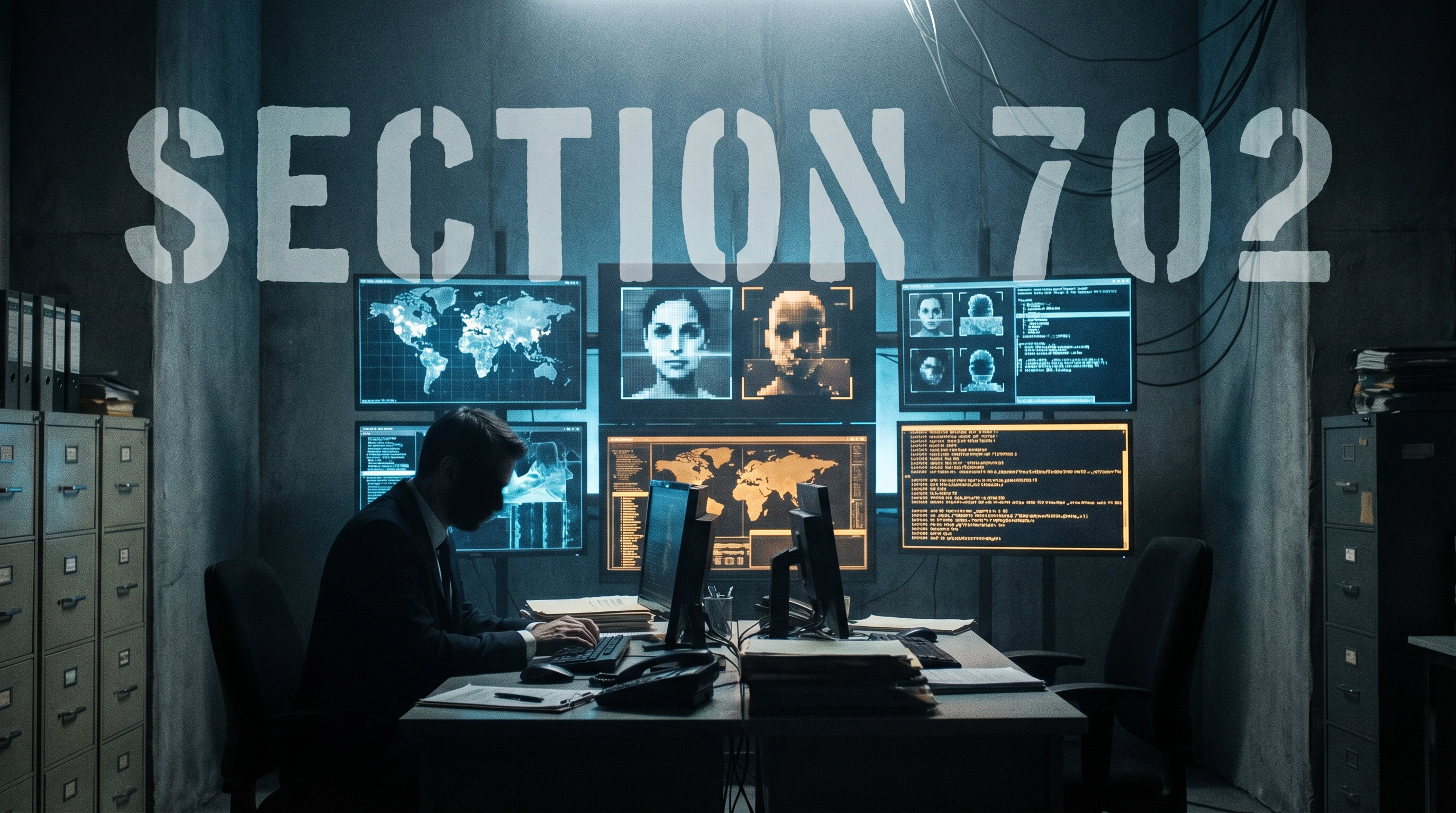
For years, the debate over Section 702 of the Foreign Intelligence Surveillance Act followed a predictable script. National security hawks argued the provision was essential to stopping terrorism. Civil libertarians warned it was a backdoor into Americans' private communications. Congress would argue, extend the law, and move on. The underlying technology stayed roughly the same.
That script no longer applies. The reauthorization fight playing out on Capitol Hill this week is categorically different from every previous one, because the surveillance tool at the center of the debate has been fundamentally transformed by artificial intelligence. What was once a targeted foreign intelligence program has become, in the hands of AI-enabled analysis, something closer to a mass surveillance infrastructure — one that can process millions of communications in the time it once took an analyst to read a single file.
What Section 702 Actually Does
Section 702, passed in 2008 as part of the FISA Amendments Act, authorizes the government to collect the communications of foreign nationals located outside the United States. The authority is sweeping: the NSA, FBI, and CIA can compel American technology companies — Google, Microsoft, Apple, Meta — to hand over emails, messages, and other digital communications when those communications involve foreign intelligence targets.
The catch, which has generated controversy for nearly two decades, is that Americans' communications are routinely swept up in this collection. When an American emails a foreign national who is a surveillance target, that email is collected. When an American calls a foreign contact, that call may be recorded. The government then maintains the right to search through this accumulated data without obtaining a warrant — a practice civil liberties advocates call backdoor searches.
"Imagine instead of doing a query with one person that you turned AI loose on these databases. There's virtually nothing the government can't know about you."
— Rep. Thomas Massie (R-KY), House press conference, April 24, 2026
For most of Section 702's history, these backdoor searches were constrained by practical limitations. Human analysts could only process so much data. Queries had to be specific. The sheer volume of collected communications acted as a natural brake on the program's reach. Those constraints are now disappearing.
The AI Transformation
The intelligence community has been integrating AI tools into its analytical workflows for several years, but the pace of adoption has accelerated sharply since 2024. Modern large language models and pattern-recognition systems can now process and cross-reference millions of communications in hours, identify behavioral patterns across years of data, and flag individuals for further scrutiny based on probabilistic assessments rather than specific suspicion.
The implications for Section 702 are profound. A human analyst running a backdoor search on a specific American suspect is a targeted act. An AI system running continuous pattern-matching queries across the entire Section 702 database is something qualitatively different — closer to what privacy advocates have long described as a general warrant, the kind of broad, suspicionless search that the Fourth Amendment was specifically designed to prohibit.
This is not a hypothetical concern. The Privacy and Civil Liberties Oversight Board, before the Trump administration effectively hollowed it out by removing members, documented numerous cases in which Section 702 data was used to investigate Americans who were never suspected of foreign intelligence connections. AI tools make such mission creep not just possible but nearly automatic.
The Congressional Battle
Section 702 was set to expire on Monday, April 21. After a dramatic midnight vote in which 20 House Republicans — many from the conservative House Freedom Caucus — blocked Speaker Mike Johnson's attempt to pass a five-year clean reauthorization, Congress agreed to a 10-day extension to allow further negotiation.
The bipartisan coalition pushing for reform is unusually broad. Rep. Warren Davidson of Ohio and Sen. Ron Wyden of Oregon have introduced the Government Surveillance Reform Act, which would require the government to obtain a warrant before conducting backdoor searches of Americans' data collected under Section 702. The bill has co-sponsors from both parties and has attracted support from civil liberties organizations across the ideological spectrum, from the ACLU to the libertarian Cato Institute.
Data Visualization
Section 702 Backdoor Searches of U.S. Persons (Estimated Annual)
- searches
Speaker Johnson's latest proposal, released Thursday, would extend Section 702 for three years and add some procedural safeguards — enhanced logging requirements, additional congressional oversight mechanisms, and restrictions on using the database to investigate certain categories of domestic crimes. But the bill stops well short of requiring warrants for backdoor searches, the central demand of the reform coalition.
Sen. Wyden's response was unsparing: 'The latest House FISA bill is a rubber stamp for Trump and Kash Patel to spy on Americans without a warrant. Don't fall for fake reforms.' Rep. Jamie Raskin, a Democrat who voted for Section 702 reauthorization in 2024, announced he would oppose any extension without meaningful warrant protections, citing the Trump administration's removal of oversight board members as evidence that existing safeguards cannot be trusted.
The Intelligence Community's Counter-Argument
The CIA, NSA, and FBI have mounted an aggressive lobbying campaign for clean reauthorization, arguing that Section 702 is indispensable to American national security. Intelligence officials point to specific cases in which the program has disrupted terrorist plots, including a 2023 threat against Taylor Swift concerts in Vienna that was thwarted in part through Section 702 intelligence.
The White House has pushed congressional Republicans to pass a clean extension, and the administration's position has not changed despite the failed votes. A White House spokesperson told NBC News the administration 'continues to have positive conversations and remains open to proposals that Congress can reach consensus on.' Intelligence officials argue that a warrant requirement would create operational delays that could cost lives in time-sensitive situations.
The Due Process Institute's Jason Pye, who supports reform, acknowledges the genuine security value of Section 702 while arguing that the warrant question is distinct from the program's core function. 'Section 702 is so vast that it incidentally collects Americans' information. The FBI can then search for a person, for an American, without a warrant. That's what we're trying to solve — not the foreign intelligence collection itself, but the backdoor access to Americans' data.'
The AI Loophole That Nobody Is Talking About
Lost in the warrant debate is a more fundamental question that neither Johnson's bill nor the reform coalition's proposal fully addresses: what happens when AI systems, rather than human analysts, are conducting the searches? Current FISA law was written with human-initiated queries in mind. It sets standards for when a human analyst can search the database. It says nothing about automated AI systems that run continuous pattern-matching operations across the entire database without any individual query being initiated.
Privacy advocates argue this is a critical gap. If an AI system is continuously analyzing all Section 702 data and flagging Americans for further scrutiny, is that a 'search' under the Fourth Amendment? Does it require a warrant? The law is silent, and the intelligence community has shown no inclination to seek legislative clarity on a question that, if answered unfavorably, would significantly constrain its AI surveillance capabilities.
The 10-day extension expires at the end of this week. If Congress cannot agree on a path forward, Section 702 authority will technically lapse — though a legislative provision means that existing collection orders will continue to be valid through March 2027. The practical effect of expiration would be limited in the short term, but the political signal would be significant: for the first time since 2008, Congress would have declined to reauthorize the government's most powerful domestic surveillance tool.
Whether that outcome would force a genuine reckoning with AI-enabled surveillance, or simply produce another short-term extension with cosmetic reforms, remains to be seen. What is clear is that the surveillance debate has entered a new era — one in which the technology has outpaced the law, and the gap between what the government can do and what it is legally permitted to do is wider than at any point in the program's history.